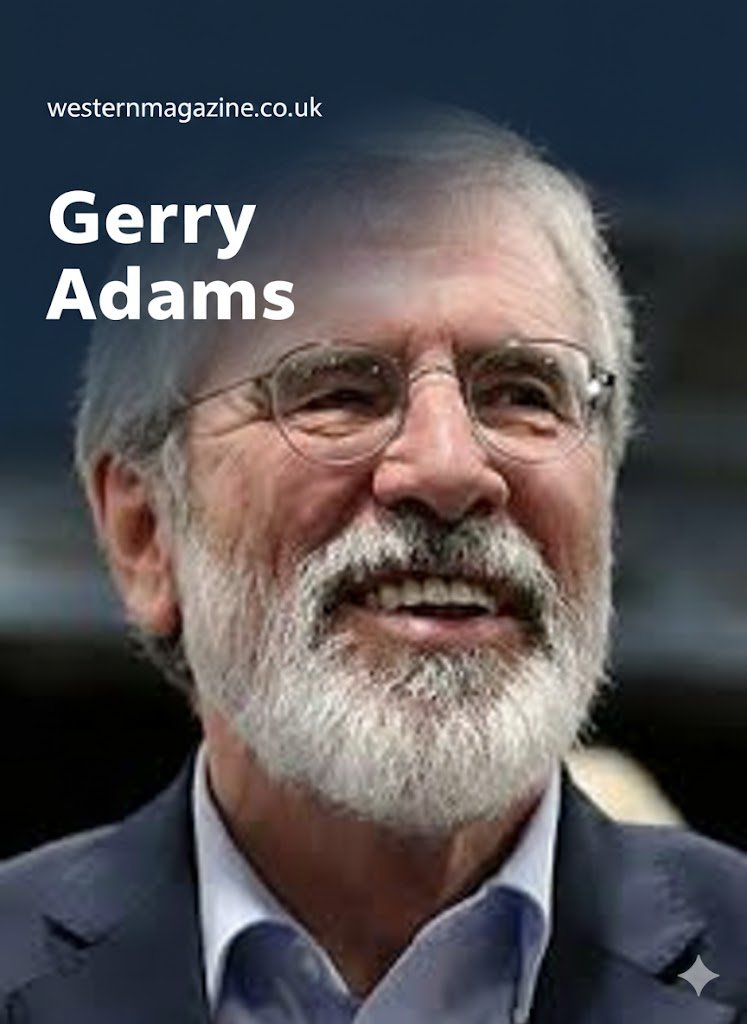
Gerry Adams
Gerry Adams, the controversial figure often associated with Northern Ireland’s political and paramilitary struggles, has spent decades at the heart of the Irish Republican movement. His name is inextricably linked to the Provisional Irish Republican Army (IRA), Sinn Féin, and the wider conflict known as the Troubles, which raged in Northern Ireland for much of the late 20th century. Yet, Adams’s life spans much more than just the violence of the past. He is also a key figure in the peace process, political transformation, and the enduring search for Irish unity. This article delves into the complex life of Gerry Adams — from his early years in Belfast to his role in the IRA, his leadership of Sinn Féin, his family life, and his enduring legacy.
Gerry Adams Early Life and Family Background
Gerry Adams was born on October 6, 1948, in Belfast, Northern Ireland. He was the oldest son in a family of ten children, born to Gerry Adams Sr. and Annie Hannaway Adams. His father, a devout Catholic and a committed Irish republican, had been involved with the Irish Republican Army in his younger days and spent time in jail for his activities. Adams Sr.’s deep republican beliefs and his active participation in the Irish nationalist cause had a significant influence on his son, shaping his own views on Irish politics and nationalism.
Adams grew up in the Ballymurphy area of Belfast, a working-class Catholic district, which would later become notorious as a stronghold for republicans and the site of significant clashes during the Troubles. As a child, he was exposed to the harsh realities of life in Northern Ireland, where the Catholic community often faced discrimination, economic inequality, and violence at the hands of Protestant unionists and the British state. This environment played a formative role in Adams’s early life and political awakening.
Adams attended St. Finian’s Primary School and St. Mary’s Christian Brothers Grammar School, institutions that were part of the Catholic educational system in Belfast. Despite showing early academic promise, Adams left school at the age of 16, seeking work in various jobs including that of a bartender in a local pub, a common occupation in his community.
Political Awakening and the 1960s
Adams’s political awakening came during the 1960s when he became involved in the civil rights movement in Northern Ireland. The Northern Ireland Civil Rights Association (NICRA) was founded in 1967, and it focused on challenging the systemic discrimination faced by Catholics in housing, voting, and employment. Inspired by global movements for civil rights and social justice, Adams joined the NICRA in 1967, and soon became an active member in organizing protests and demonstrations.
By the late 1960s, the situation in Northern Ireland had begun to deteriorate rapidly. Tensions between the Catholic nationalist community and the Protestant unionist majority erupted into violence. The Battle of the Bogside in 1969 marked a turning point, and the British Army was deployed to restore order, deepening sectarian tensions.
During this period, Adams joined Sinn Féin, the political party with deep roots in the republican movement. Sinn Féin, once a marginal party, was rapidly gaining support from nationalist communities. Adams’s growing disillusionment with peaceful protest led him to embrace more militant forms of resistance, and he would soon be closely associated with the Provisional IRA, which was formed in 1969 following a split within the republican movement.
The 1970s: The IRA, Internment, and Increasing Radicalization
The early 1970s were tumultuous for Northern Ireland. Following the Bloody Sunday massacre of 13 unarmed civil rights protesters in Derry in 1972, many nationalists turned toward armed resistance as the only viable means of confronting British rule. The Provisional IRA, which Adams was alleged to be a member of, escalated its campaign against the British Army and loyalist paramilitaries.
In 1971, Adams was interned by the British Army under the controversial internment policy, which allowed for the detention of individuals without trial. His time in prison was brief but pivotal. After his release, Adams continued his involvement with Sinn Féin, which was increasingly seen as the political arm of the IRA. His rise in the ranks of Sinn Féin coincided with the growing power of the IRA, which was carrying out numerous bombings, shootings, and other violent acts aimed at ending British control over Northern Ireland.
Though Adams has consistently denied being a member of the IRA, numerous sources, including former IRA members and British intelligence reports, suggest that he played a significant role within the organization, possibly as a member of its Army Council. He has always maintained that his role was strictly political, and he has been adamant that he was never directly involved in planning or carrying out military operations.
Sinn Féin Leadership and the Shift Toward Politics
By the late 1970s, Adams had become one of the leading figures in Sinn Féin. In 1983, he was elected Vice President of Sinn Féin, and in 1987, he became the party’s President — a position he would hold for over three decades. As president, Adams sought to move Sinn Féin from its traditional base of paramilitary supporters toward greater political engagement, though this was often done in parallel with the IRA’s continued armed struggle.
Adams’s political strategy was based on the notion of combining armed struggle with political activism, a dual approach that he described as “the Armalite and ballot box” strategy. This meant that Sinn Féin would continue to engage in the political process while also supporting the IRA’s armed struggle for a united Ireland.
Under his leadership, Sinn Féin began to gain electoral success, particularly in the Republic of Ireland. Adams himself was elected to the British Parliament in 1983 as the Member of Parliament (MP) for Belfast West. However, following Sinn Féin’s policy, he refused to take his seat, as he would have been required to swear an oath of allegiance to the British monarch.
Adams’s leadership was instrumental in the party’s transformation from a marginal nationalist group into a significant political force. He navigated Sinn Féin through turbulent times, winning respect from the nationalist community for his leadership while drawing intense criticism from unionists, loyalists, and the British government.
The Good Friday Agreement and the Peace Process
The 1990s brought a profound shift in both Sinn Féin’s strategy and the broader political landscape of Northern Ireland. After years of violence, peace talks were initiated, and in 1994, the IRA declared a ceasefire, signaling the start of a long negotiation process. The culmination of these talks came in 1998, when the Good Friday Agreement was signed. This historic agreement established a devolved government in Northern Ireland and laid the foundation for peaceful coexistence between nationalist and unionist communities.
Gerry Adams played a pivotal role in the peace process. While Sinn Féin’s association with the IRA’s past activities continued to be a point of contention, Adams worked tirelessly to convince the IRA to commit to peace. The Good Friday Agreement was a significant victory for Adams, who now saw political means as the best path forward for achieving Irish unification.
Following the peace agreement, Sinn Féin gained greater political representation. Adams continued to serve as MP for Belfast West and later as a member of the Northern Ireland Assembly. The 2000s and 2010s saw Sinn Féin emerge as a dominant force in Northern Ireland’s politics, with Adams playing a central role in the party’s transformation.
Personal Life: Family, Wife, and Children
While Gerry Adams’s public life has been intensely scrutinized, his private life has remained relatively under the radar. Adams married Colette McArdle in 1971, and the couple has several children together. McArdle, a teacher, has largely remained out of the public eye and has not been involved in the political spotlight, despite her husband’s prominent position in Irish politics.
Adams has often cited his family as a source of personal strength, and his children were raised in the midst of the Troubles, witnessing firsthand the violence and political activism that defined much of their father’s life. Despite his public prominence, Adams has kept his personal life private, preferring to focus on his political work.
Gerry Adams Net Worth and Financial Profile
Estimating @Gerry Adams’s net worth has proven to be a challenge due to his long career in politics, the sources of his income, and the relatively low transparency regarding the financial details of his personal life. However, several estimates place his net worth in the low millions of dollars, with some sources suggesting figures ranging from $5 million to $10 million.
Adams’s wealth has primarily come from his political career, book sales, public speaking engagements, and his pension as a long-time parliamentarian. Despite his significant political influence, Adams has often lived modestly compared to other political leaders, focusing on his cause rather than amassing great wealth.
Gerry Adams Legacy and Continuing Impact
Adams’s legacy is deeply intertwined with the history of Northern Ireland and the broader Irish struggle for independence and unity. While his early involvement in the IRA and his long-standing role as the head of Sinn Féin make him a polarizing figure, he has also been credited with playing a key role in moving the Irish Republican movement toward peace and political negotiation.
His leadership in the Good Friday Agreement and his ability to navigate the complex politics of Northern Ireland have solidified his place as one of the most important figures in recent Irish history. As a politician, Adams has shown that a commitment to political change, even in the face of violence and adversity, can lead to progress.
While he retired from the leadership of Sinn Féin in 2018, Adams continues to influence Irish politics, and his place in history remains firmly entrenched. Whether viewed as a hero of the Irish people or a symbol of controversial violence, Gerry Adams’s legacy is one that will continue to shape the future of Ireland for generations to come.
About the Author