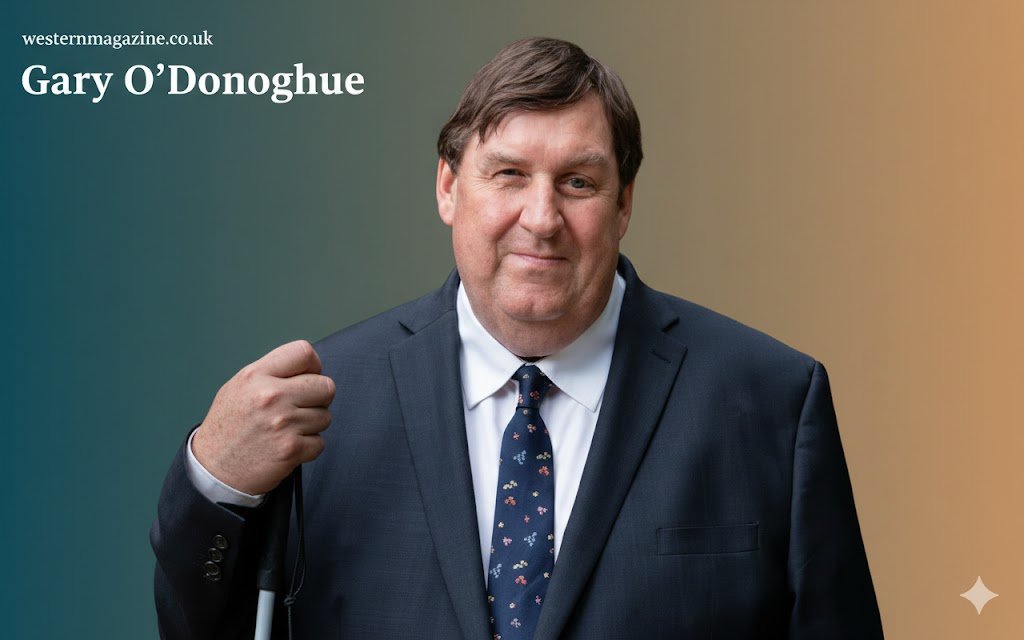
Gary O'Donoghue
Introduction
Gary O’Donoghue is a renowned British journalist who has become one of the most influential figures in modern political reporting. His career at the BBC spans decades of coverage of major political events, global crises, and shifting international landscapes. What makes his journey particularly inspiring is the fact that O’Donoghue has been blind since childhood. Despite this, he has risen through the ranks of the BBC, breaking barriers and redefining the role of a journalist with a disability. His story is one of resilience, overcoming adversity, and paving the way for greater inclusivity in the media.
In this article, we will explore O’Donoghue’s life, career, his experiences in 2009, his role as a blind journalist, and the remarkable milestones that shaped his legacy.
Gary O’Donoghue Early Life and Education
Birth and Family Background
Gary O’Donoghue was born in 1968 in London, England. Growing up in a working-class family, he developed a strong sense of determination from an early age. His father was a semi-professional footballer and a taxi driver, and his mother worked as a ballroom dance instructor. The O’Donoghue family valued hard work and independence, values that Gary would carry throughout his life.
Losing His Sight
At the age of eight, O’Donoghue lost his sight completely due to a series of retinal detachments. While he was not born blind, the vision loss was gradual, and by his childhood, he was left without any visual perception. Despite the challenges that came with losing his sight, O’Donoghue’s parents made sure to encourage his independence. They enrolled him in the Worcester College for the Blind, a school that would become instrumental in shaping his early years and instilling in him a belief that he could achieve anything.
Education and Interests
Gary was an academically gifted student, excelling in subjects such as philosophy and modern languages. After completing his studies at Worcester College for the Blind, he went on to study at Christ Church, University of Oxford, where he earned a degree in philosophy and modern languages. It was at Oxford that O’Donoghue developed a keen interest in current affairs and politics — interests that would later define his journalistic career.
Gary O’Donoghue Career Beginnings
Entering Journalism
Upon graduating from Oxford, Gary O’Donoghue made the bold decision to pursue a career in journalism. Initially, his path was challenging, as the media industry was not known for being particularly accessible to individuals with disabilities. However, O’Donoghue’s determination and his academic background made him an attractive candidate for a career in reporting.
His break came when he joined the BBC. O’Donoghue started with work experience and quickly moved to a full-time position. His early work focused on radio reporting, producing stories for BBC Radio 4’s flagship Today programme. He gained experience covering everything from global conflicts to political developments, gradually making a name for himself within the industry.
Facing Challenges in the Workplace
Although O’Donoghue’s early career in journalism was marked by successes, it was also defined by challenges. The BBC, like many media organizations at the time, had limited accessibility for visually impaired employees. O’Donoghue was forced to rely on colleagues to help him with reading printed material and navigating newsroom spaces. Despite these barriers, he forged ahead, developing a distinctive voice in reporting and gaining the respect of his colleagues.
O’Donoghue’s rise was not without obstacles, however. In 2008, he faced disability discrimination when a BBC producer reassigned one of his high-profile political stories to a sighted reporter. This issue was settled with the BBC, which acknowledged that it had failed to adequately support O’Donoghue. The incident highlighted the challenges faced by disabled professionals and led to a broader conversation about inclusion in the workplace.
Gary O’Donoghue Role at the BBC
Political Correspondent
By 2004, O’Donoghue had firmly established himself as a leading political correspondent at the BBC. He began reporting extensively on UK politics from Westminster and also worked for BBC’s flagship programmes like Today and PM. In this role, O’Donoghue provided crucial political analysis, often during high-pressure moments, such as election campaigns and national crises.
His notable political coverage includes the 2005 UK General Election, Gordon Brown’s tenure as Prime Minister, and the Brexit referendum — issues that defined political discourse in the UK over the years.
Covering Global Political Events
In 2007, O’Donoghue moved into international coverage, reporting on major political events across the globe. He covered stories such as the rise of populist movements, the financial crises of 2008, and the intensification of conflicts in the Middle East. His ability to provide insightful analysis made him one of the BBC’s most valued political voices.
A Blind Journalist Unique Perspective
O’Donoghue has often spoken about how his blindness offers a unique perspective in his journalism. While many reporters focus on visual elements in their coverage, O’Donoghue’s lack of sight means he focuses more intently on sound, dialogue, and human nuances — an approach that gives his reports a deeper, more emotional quality. His blindness, he has argued, actually enhances his ability to listen carefully and understand the subtext of interviews, speeches, and public events.
The Year 2009: Gary O’Donoghue A Turning Point
Around 2009, @O’Donoghue was beginning to gain widespread recognition for his work, both as a political correspondent and as a figure advocating for greater representation of disabled people in the media. It was during this time that O’Donoghue made some of his most important career strides.
While much of his career had already been marked by political reporting, 2009 was particularly significant because of his increased public profile and the challenges he faced in the workplace. During this period, he publicly discussed the barriers that blind individuals face in finding equal employment opportunities, specifically within the media industry. His story became an inspiration to others with disabilities who aspired to enter fields that had been traditionally closed off to them.
Gary O’Donoghue Move to Washington, D.C.
In 2014, O’Donoghue was appointed as the BBC’s Chief North America Political Correspondent based in Washington, D.C. This promotion marked the next stage of his career, as he transitioned from UK-based political reporting to covering the U.S. political scene.
In this new role, O’Donoghue covered presidential campaigns, congressional politics, and international relations under the Obama and Trump administrations. His extensive knowledge of politics, combined with his ability to provide insightful analysis, made him a crucial part of the BBC’s coverage of American political affairs.
Gary O’Donoghue Impact as a Blind Journalist
O’Donoghue has never allowed his blindness to define his limits. Instead, he has become a trailblazer in the journalism world, pushing boundaries and challenging stereotypes about what blind people can achieve. His journey demonstrates the importance of accessibility and inclusion for disabled individuals in all industries, particularly in media.
Through his career, O’Donoghue has shown that blindness need not be an obstacle to professional success. Instead, it can be a source of strength — offering a different perspective and a deeper understanding of human stories.
His work continues to inspire future generations of journalists, especially those with disabilities, to pursue their careers with passion, confidence, and resilience. He is a living example of how, with the right tools, technology, and support, individuals can overcome significant challenges and excel in their chosen fields.
Personal Life and Advocacy
O’Donoghue’s personal life is just as impactful as his professional one. He is married to Sarah Lewthwaite, a fellow journalist, and together they have a daughter. Despite his demanding career, O’Donoghue has always made time for his family, and they divide their time between the United Kingdom and the United States.
In addition to his journalistic work, O’Donoghue is an advocate for disability rights. He has consistently worked to raise awareness about the issues that blind people face in the workplace, in education, and in society at large. His commitment to advocacy has made him a powerful voice for inclusion, both within the BBC and in the wider media landscape.
Conclusion
Gary O’Donoghue’s career is a testament to the power of resilience, determination, and inclusivity. Despite losing his sight at a young age, O’Donoghue has risen to become one of the most respected political correspondents at the BBC, covering major political events both in the UK and the United States.
His story shows that with the right support and technology, people with disabilities can not only succeed in demanding fields like journalism but can also excel and become leaders in their industries. Through his work, O’Donoghue continues to inspire people with disabilities to pursue their dreams, advocating for a more inclusive and accessible world where people are judged on their abilities rather than their disabilities.
O’Donoghue’s legacy as a blind journalist has forever changed the media landscape, setting a powerful example of how we can all overcome obstacles, break stereotypes, and make a lasting impact on the world.
About the Author