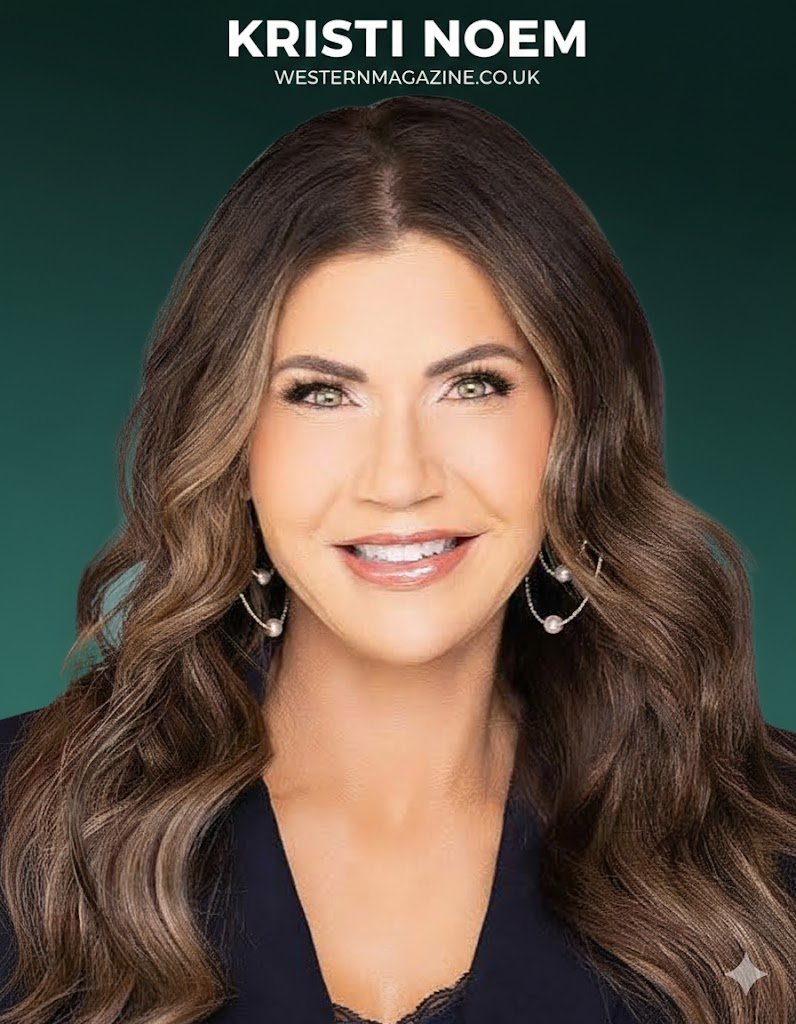
Kristi Noem
Kristi Noem was born on November 30, 1971, in Watertown, South Dakota, and was raised on her family’s farm and ranch in Hamlin County. Her childhood was shaped by agriculture, livestock management, faith, and small-town community values. Growing up in a rural environment gave her firsthand experience with farming economics, land stewardship, and the challenges facing American ranchers. These early experiences later became foundational to her political messaging, where she frequently highlights her identity as a rancher, businesswoman, and mother.
A pivotal moment in her early life occurred when her father died in a farming accident. As a young adult, she returned home to help manage the family ranch alongside her siblings and husband, Bryon Noem. This responsibility interrupted her college education, though she later completed her political science degree while serving in Congress. Her personal story of resilience and rural entrepreneurship became a central narrative in her political career.
Kristi Noem Entry Into State Politics
Kristi Noem entered public office in 2006 when she was elected to the South Dakota House of Representatives. Representing her district for two terms, she quickly established herself as a conservative voice focused on limited government, tax reduction, agricultural interests, and property rights. Her legislative work reflected a belief in minimizing regulatory burdens and supporting local economic growth.
During her time in the state legislature, she rose to serve as Assistant Majority Leader. Her leadership position demonstrated her growing influence within the Republican Party at the state level. These early years in public service helped her develop policy experience and political networks that would propel her to national office.
Kristi Noem Service in the U.S. House of Representatives
In 2010, Kristi Noem was elected to represent South Dakota’s at-large congressional district in the U.S. House of Representatives. Her victory came during a strong Republican wave year and marked her transition to national politics. She went on to serve four terms in Congress from 2011 to 2019.
During her tenure, she focused heavily on tax reform, agricultural policy, energy independence, and opposition to federal expansion. She became the first South Dakotan to sit on the House Ways and Means Committee, one of the most influential committees in Congress. In that role, she supported the Tax Cuts and Jobs Act, advocating for lower tax rates and economic growth.
Her congressional record consistently aligned with conservative priorities. She supported Second Amendment protections, voted against expanding federal healthcare programs, and opposed environmental regulations she viewed as harmful to farmers and businesses. Over time, she built a reputation as a disciplined and reliable Republican lawmaker.
Kristi Noem Becoming Governor of South Dakota
In 2018, Kristi Noem ran for governor of South Dakota and won, becoming the first female governor in the state’s history. Her victory marked a historic milestone and elevated her national profile within the Republican Party.
As governor, she prioritized economic development, business expansion, and maintaining South Dakota’s low-tax environment. She consistently promoted the state’s lack of income tax as a competitive advantage for attracting businesses and residents. Workforce development and rural economic growth initiatives were central components of her agenda.
Her governorship also brought her significant national attention, particularly during the COVID-19 pandemic. While many states implemented strict lockdowns and mask mandates, Noem resisted statewide mandates and instead emphasized personal responsibility. She framed her approach as a defense of individual liberty and economic freedom. Supporters praised her decision to keep businesses open, while critics argued that stronger public health measures were necessary. The debate surrounding her pandemic response solidified her position as a prominent conservative figure.
Kristi Noem Cultural and Social Policy Initiatives
During her time as governor, Noem signed several high-profile social policy bills into law. She supported legislation restricting transgender athletes from participating in women’s sports and signed laws limiting certain medical procedures for minors related to gender transition. These measures positioned her as a leading voice in the national cultural policy debate.
She also strongly supported pro-life legislation following major shifts in federal abortion law. Her administration emphasized traditional family values and religious freedom protections. These actions strengthened her support among social conservatives but also drew criticism from civil rights organizations and progressive groups.
Her leadership in cultural issues further amplified her national recognition, placing her at the forefront of ongoing debates over gender identity, parental rights, and education policy.
Kristi Noem Relationship With Tribal Governments
Kristi Noem’s tenure as governor included tensions with Native American tribal governments within South Dakota. Public statements she made regarding criminal activity and border security created friction with tribal leaders. Some tribal officials criticized her rhetoric, arguing that it unfairly characterized tribal communities. The strained relationship became a significant political issue within the state.
Despite these tensions, Noem maintained that her policies were focused on law enforcement and public safety rather than targeting specific communities. The disagreement highlighted the complexities of state-tribal relations and the political sensitivity of public safety discussions.
Appointment as Secretary of Homeland Security
Following her governorship, Kristi Noem was appointed to serve as U.S. Secretary of Homeland Security. This Cabinet-level position placed her in charge of one of the largest federal departments, overseeing border security, immigration enforcement, disaster response, cybersecurity, and transportation security.
Her appointment signaled a clear emphasis on strengthening immigration enforcement and enhancing border protection. The Department of Homeland Security includes agencies such as Customs and Border Protection, Immigration and Customs Enforcement, the Federal Emergency Management Agency, and the Transportation Security Administration. Leading such a vast organization required administrative oversight, coordination across agencies, and strategic national security planning.
Her transition from state executive leadership to federal Cabinet leadership marked a significant expansion of her political influence.
Immigration and Border Enforcement Priorities
Immigration policy became central to Noem’s federal leadership. She advocated for expanded border enforcement, increased resources for immigration officers, and stricter asylum standards. Her approach framed immigration primarily as a matter of national security and law enforcement.
Supporters argue that her policies prioritize public safety, reduce drug trafficking, and reinforce the rule of law. Critics contend that strict enforcement measures may negatively affect humanitarian protections and immigrant communities.
Her leadership in this area reflects the broader Republican focus on border security as a defining national issue. Immigration enforcement has remained one of the most visible aspects of her tenure at Homeland Security.
Kristi Noem Leadership Style and Public Communication
Kristi Noem is widely recognized for her assertive leadership style and strategic media presence. She frequently communicates directly with voters through interviews, public speeches, and social media. Her messaging often emphasizes freedom, constitutional rights, and resistance to federal overreach.
She projects confidence and decisiveness, qualities that resonate strongly with her political base. At the same time, critics argue that her approach can be polarizing. Regardless of perspective, her communication style has played a major role in maintaining her national visibility.
Her political brand combines traditional conservative principles with a modern media-savvy presentation, enabling her to maintain influence beyond her home state.
Kristi Noem Major Controversies and Public Scrutiny
Throughout her career, @Kristi Noem has faced various controversies. Questions have been raised regarding ethics disclosures and financial matters related to political organizations. While investigations did not result in criminal charges, the issues generated public debate about transparency.
Additional controversy arose from her memoir, in which personal stories received widespread media attention and sparked national conversation. Her handling of certain state-level licensing matters involving family members also drew scrutiny and criticism from political opponents.
In federal office, reports of internal restructuring and personnel turnover within Homeland Security prompted discussion about management style and departmental culture. Supporters argue that organizational changes are necessary for reform, while critics suggest they may disrupt agency operations.
These controversies have contributed to her image as both a bold reformer and a polarizing political figure.
Political Ideology and Conservative Influence
Kristi Noem’s political ideology aligns closely with conservative populism. She emphasizes limited government, strong national borders, religious freedom, gun rights, and economic deregulation. She frequently frames her policy positions as defenses of constitutional liberties and American sovereignty.
Her consistent adherence to these principles has made her a prominent figure within the Republican Party. She is often mentioned in discussions about future national leadership roles and has become one of the most recognized Republican women in American politics.
Her influence extends beyond specific offices she has held. She represents a broader ideological movement that prioritizes state autonomy, cultural traditionalism, and assertive national security policies.
Kristi Noem Legacy and Historical Significance
Kristi Noem’s career reflects significant milestones in American political history. As South Dakota’s first female governor and later a Cabinet-level official, she has broken gender barriers within conservative politics. Her rise from rural rancher to national leader underscores the evolving role of women within the Republican Party.
Her legacy will likely be defined by her pandemic governance approach, her leadership in immigration policy, and her role in shaping modern conservative discourse. Whether viewed as a defender of individual liberty or as a divisive political actor, her impact on contemporary American politics is undeniable.
Kristi Noem remains a central figure in the ongoing debate over the direction of conservative leadership in the United States.
About the Author