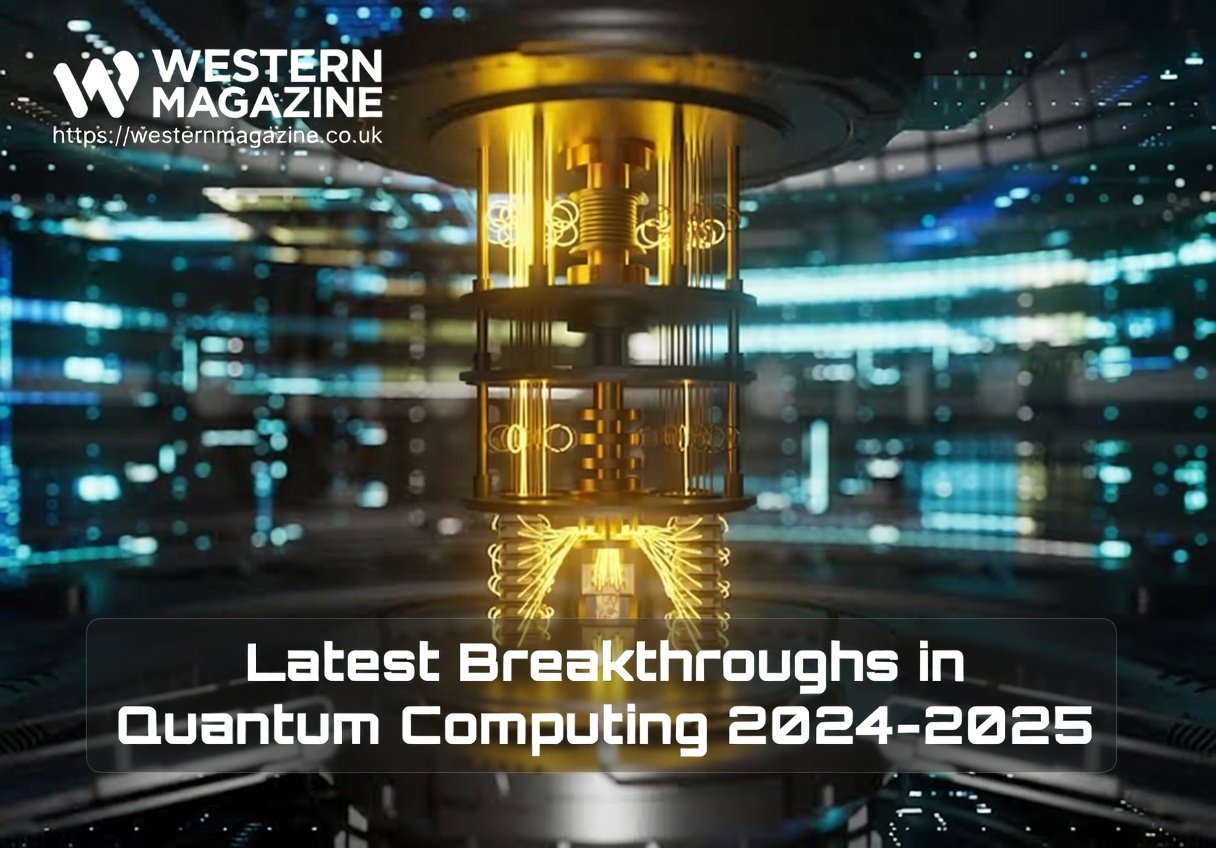
Latest Breakthroughs in Quantum Computing 2024–2025
Quantum computing is no longer just a concept in research labs—it is rapidly advancing toward real-world applications. The years Latest Breakthroughs in Quantum Computing 2024–2025 have already seen major breakthroughs in hardware, algorithms, error correction, and global infrastructure, bringing us closer to practical quantum machines that could revolutionize industries from medicine to finance.In this article, we explore the latest developments in quantum computing, their significance, and what the future may hold.
What is Quantum Computing?
At its core, quantum computing leverages the principles of quantum mechanics, such as superposition and entanglement, to process information in ways that classical computers cannot. Unlike traditional bits that are either 0 or 1, qubits can represent both at the same time, allowing quantum computers to perform complex calculations more efficiently.
For decades, quantum computing remained largely experimental, with researchers struggling to scale qubits, reduce errors, and develop usable algorithms. However, 2024–2025 has seen significant strides in all these areas.
Latest Breakthroughs in Quantum Computing 2024–2025 Hardware Breakthroughs
Scaling Qubits
One of the biggest challenges in quantum computing has been increasing the number of qubits while maintaining stability.
- In 2024, Google unveiled the Willow processor with 105 superconducting qubits. It performed computations previously impossible for classical supercomputers within a reasonable timeframe.
- Neutral atom quantum systems, developed by institutions like Caltech and MIT, now demonstrate thousands of qubits, with arrays of 3,000 to 6,000 atoms manipulated with high precision.
- Advanced 3D wiring architectures allow qubits to be densely connected on chips, supporting future scaling toward tens of thousands of qubits.
These hardware developments are crucial for building machines that can solve meaningful problems rather than just benchmarks.
Latest Breakthroughs in Quantum Computing 2024–2025 Topological and Photonic Qubits
Another breakthrough involves new types of qubits:
- Topological qubits, pioneered by Microsoft, offer natural error resistance due to their quantum properties, potentially reducing the need for extensive error correction.
- Photonic qubits use light particles, enabling scalable architectures that integrate with existing semiconductor fabrication techniques. Companies like PsiQuantum are leading this area, promising larger quantum systems with higher reliability.
These innovations bring us closer to fault-tolerant quantum computers.
Latest Breakthroughs in Quantum Computing 2024–2025Error Correction and Fault Tolerance
Quantum computers are prone to errors caused by decoherence and environmental noise. Overcoming this requires fault-tolerant architectures:
- Logical qubits, composed of many physical qubits, are now operational in some research labs, outperforming the individual physical qubits.
- Techniques like magic state distillation and hybrid error mitigation reduce the number of physical qubits needed for stable computation.
These advances mark the transition from noisy intermediate-scale quantum (NISQ) devices to machines capable of real-world problem-solving.
Quantum Algorithms and Practical Applications
Quantum computing is not just about hardware; it also depends on algorithms that can exploit qubit capabilities:
- Google’s Quantum Echo algorithm demonstrated a performance boost for simulating molecular systems, completing tasks thousands of times faster than classical simulations.
- Quantum algorithms for optimization, cryptography, and materials science are now being tested in realistic scenarios.
- Error-mitigated quantum simulations are helping researchers model chemical reactions for drug discovery and renewable energy materials, providing a glimpse into practical quantum utility.
These algorithmic advances show that quantum computing is moving beyond laboratory proofs toward tangible applications.
Global Investment and Infrastructure
The last two years have seen massive public and private investment in quantum computing:
- Startups like PsiQuantum and Rigetti are building large-scale facilities to support scalable quantum systems.
- Governments worldwide are allocating billions to quantum research, aiming for technological leadership in this emerging field.
- Universities and industry collaborations are creating quantum hubs, combining research, talent, and commercial development.
This investment ecosystem is essential for turning breakthroughs into widely usable quantum computers.
Latest Breakthroughs in Quantum Computing 2024–2025 Future Directions
Looking ahead, quantum computing is likely to see:
- Hybrid classical-quantum systems that integrate quantum processors into cloud platforms for business applications.
- Continued improvement in qubit stability and error correction, making larger machines practical.
- Widespread industry adoption in sectors like finance, pharmaceuticals, and logistics within the next five years.
- Research into new quantum materials and architectures, including topological qubits, trapped ions, and photonics.
These directions suggest that quantum computing is on the verge of transitioning from experimental to practical and impactful technology.
Challenges Still Ahead
Despite progress, several challenges remain:
- Maintaining coherence in large qubit arrays.
- Developing user-friendly quantum programming tools.
- Scaling up error-corrected logical qubits to support meaningful applications.
- Addressing cost and infrastructure barriers for widespread adoption.
Overcoming these challenges will require continued innovation and collaboration between industry, academia, and governments.
Conclusion
The years 2024–2025 have been transformative for quantum computing. With breakthroughs in hardware, error correction, algorithms, and global investment, the technology is moving closer to practical applications.
While large-scale commercial quantum computers are still emerging, the progress seen now suggests that solving problems beyond classical computation is no longer a distant dream. The quantum revolution is underway, and the next few years will determine how profoundly it transforms science, industry, and society.
About the Author