cars
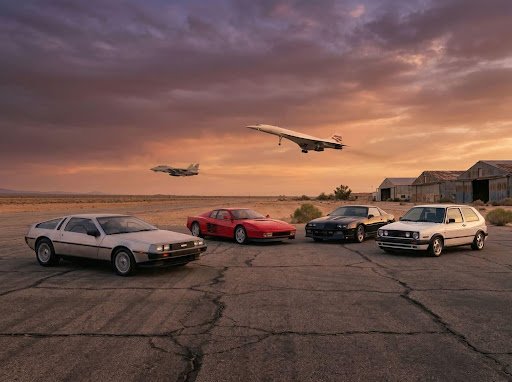
The 1980s had cars no shortage of opinions about what the future of transportation looked like. Big opinions, loudly held, frequently wrong. The decade that produced the DeLorean and the Concorde’s commercial peak also produced the Yugo and the regional jet revolution — vehicles that nobody celebrated at the time and that the collector market has been quietly rehabilitating ever since. The 1980s did not produce the most technically sophisticated vehicles in history. It produced the most culturally specific ones. And culture, it turns out, ages considerably better than technology.
The Automotive 1980s: Excess, Austerity, and Everything Between
The American automotive market of the 1980s was still recovering from the twin shocks of the 1970s oil crisis and the Japanese quality invasion. Detroit was building smaller, less powerful cars than it wanted to, competing against imports that were better made and more fuel-efficient, and simultaneously trying to rebuild a performance credibility it had lost overnight in 1973. The result was a decade of contradictions: turbocharged four-cylinders in cars that had previously used V8s, digital dashboards that added complexity without reliability, and an aesthetic vocabulary of wedge shapes and body kits that aged less gracefully than almost anything before or since.
Against this backdrop, the Yugo model car arrived in the United States in 1985 at $3,990 — the cheapest new car ever sold on American soil. The Yugo GV was a Yugoslav-assembled vehicle based on a Fiat platform, stripped to the absolute minimum by a combination of socialist manufacturing economics and the brutal requirements of its price point. It was mocked immediately and comprehensively. It was also, in its first three years, genuinely successful — 141,511 units sold to buyers who needed transport and had nothing to spare. The jokes came later, when the quality issues compounded. The car itself was never the whole story.
The broader models of automobiles that defined the decade sat at every point on the spectrum between the Yugo’s austere pragmatism and the Ferrari Testarossa’s unapologetic excess. The decade produced the first-generation Honda CRX, which demonstrated that a small car could be genuinely enjoyable to drive. It produced the Dodge Viper concept, which announced that American performance ambition had survived the 1970s intact. It produced the BMW E30 M3, which established a benchmark for the driver’s car that the industry spent the following three decades trying to match. The 1980s automotive landscape was not coherent. It was a decade of competing propositions about what a car should be — and the market’s verdict on each of them is still being written.
The Aviation 1980s: Business Jets Find Their Moment
If the automotive 1980s were defined by a market in recovery, the business aviation 1980s were defined by a market in acceleration. The decade saw business jet ownership transition from the exclusive preserve of the largest corporations to a realistic proposition for mid-sized companies and high-net-worth individuals. Manufacturers responded with a generation of light and mid-size jets that brought operating economics within reach of a genuinely broader market — and none more effectively than Cessna’s Citation family.
The Cessna 550 Citation Bravo represents the mature expression of a philosophy Cessna had been developing since the original Citation I of 1972: a light business jet that prioritised reliability, accessibility, and operating economy over outright performance. The Citation Bravo — developed through the 1990s from the 550 platform that entered service in 1978 — powered by Pratt & Whitney Canada JT15D-5B turbofans and carrying up to eight passengers at 43,000 feet, became one of the most widely operated light jets in the world. Its simplicity was a feature rather than a limitation: pilots transitioning from turboprops found the Citation family approachable in a way that more complex jets were not, and operators found the maintenance economics genuinely manageable without a dedicated heavy MRO contract.
The 1980s business aviation market also produced the Learjet 55, the Beechcraft Starship, and the first generation of what would become the regional jet sector — the Brazilian Embraer EMB 120 Brasilia and the British Aerospace ATP among them. Each represented a different answer to the same question: how do you make air transport economically viable at scales below the major airline network? The Citation’s answer — keep it simple, keep it reliable, keep it affordable to operate — proved more durable than most of its contemporaries.
The 1980s produced vehicles that were right about things the market was not yet ready to acknowledge — and wrong about things the market punished them for immediately. The collector who can tell the difference between those two categories is the one whose collection holds its value.
Why 1980s Vehicles Produce the Most Passionate Collector Responses
The collector market for 1980s automotive and aviation subjects has grown consistently since the decade’s vehicles entered the twenty-five-year classic threshold in the 2000s. The reasons are not primarily financial — few 1980s vehicles have appreciated at the rate of their 1960s equivalents. They are cultural. The people who grew up watching these vehicles define their environment are now at the age and income level where collecting is possible, and the specificity of their nostalgia is driving demand for subjects that a previous collector generation would never have considered.
The Yugo GV is collected not despite its reputation but because of it — it is the most culturally specific automobile of the 1980s, identifiable to anyone who was alive in America during that decade, and impossible to mistake for anything else. The Citation family is collected as the archetypal business jet of the era — the aircraft most likely to have been the first private jet a generation of executives ever boarded, and therefore the subject most likely to carry genuine personal significance for collectors from that professional world.
The 1980s did not produce the most admired vehicles in history. It produced the most remembered ones. And memory, in the collector market, is the resource that never depreciates.
Frequently Asked Questions
Why did the Yugo fail in the American market?
The Yugo’s American failure was primarily a consequence of its price point rather than its fundamental design. At $3,990, there was no margin for the quality control, dealer support network, or warranty provision that American buyers expected from a new car purchase. The Fiat-derived platform was sound, but the cost-cutting required to hit the price target produced reliability issues that generated disproportionate negative publicity. The 1991 United Nations sanctions on Yugoslavia ended imports definitively, but the car’s commercial trajectory had already declined significantly before that point.
What made the Cessna Citation family so commercially successful?
The Citation family’s commercial success rested on three consistent advantages: lower acquisition cost than comparable light jets, simplified systems that reduced pilot training requirements and maintenance complexity, and Cessna’s established dealer and support network from its piston and turboprop operations. The Citation was never the fastest or most glamorous light jet available — it was the most accessible and the most supportable, which proved to be the more durable competitive position across a forty-year production run.
Are 1980s vehicles worth collecting as scale models?
1980s automotive and aviation subjects are among the most culturally loaded collector categories currently growing in the scale model market. The combination of strong personal nostalgia among collectors now in their forties and fifties, relatively limited production of quality scale replicas compared to earlier classic periods, and the decade’s unusually high cultural specificity makes well-executed 1980s subjects both personally meaningful and commercially underserved. For collectors seeking subjects with genuine significance and limited competition from established collector tiers, the 1980s represents one of the most interesting opportunities in the current market.
The Decade That Knew Exactly What It Was
The 1980s had no ambiguity about its own identity. The cars were loud, the jets were purposeful, and everything from the design language to the marketing communicated a decade that had decided exactly what it thought and was not interested in being talked out of it. Some of those decisions aged well. Some aged catastrophically. The collector market, which runs on the same emotional logic as memory itself, has never distinguished particularly carefully between the two categories — and that indiscriminate affection is precisely what makes the decade’s vehicles so interesting to collect, display, and preserve in miniature for the decades that follow.
The Yugo and the Citation Bravo were never supposed to be remembered the same way as the Ferrari Testarossa or the Learjet 55. They were supposed to be useful and then forgotten. History, as it tends to do, had other plans.
About the Author