The Quiet Confidence of Old Money Style: What It Actually Means to Dress “Understated”
Few style aesthetics have generated as much conversation in recent years as “old money” fashion, yet the term is often misunderstood as simply expensive-looking clothing. In reality, the aesthetic has far less to do with visible cost and far more to do with restraint, quality, and a wardrobe built to last rather than to impress. Understanding that distinction is the real key to pulling the look off convincingly.
This guide breaks down what actually defines old money style, how it differs from adjacent aesthetics people often confuse it with, and how to build toward it without needing a designer budget.
What “Old Money” Actually Means as a Style Philosophy
At its core, old money dressing reflects a mindset more than a shopping list: clothing chosen for longevity and quality rather than trend cycles, a muted and cohesive color palette, and an overall impression of effortlessness rather than obvious effort. The goal isn’t to look wealthy in an overt way — it’s to look like style was never something you had to think too hard about, because the foundational pieces have simply always worked.
This is part of why old money style tends to photograph as timeless rather than dated even years later. Trend-driven pieces cycle out of relevance quickly, while well-made basics in classic silhouettes remain wearable for far longer, which is precisely the point of the aesthetic in the first place.
Old Money vs. Quiet Luxury: What’s the Difference?
These two terms get used almost interchangeably, but there’s a meaningful distinction worth understanding. Quiet luxury tends to emphasize extremely high-quality, minimally branded pieces — cashmere, fine tailoring, subtle logo-free luxury goods — with a modern, streamlined silhouette. Old money style pulls from a slightly different visual vocabulary: preppy references, traditional tailoring, equestrian and country-club influences, and a warmer, more heritage-leaning color palette.
In practice, the two aesthetics overlap significantly and are often styled together, but old money leans more traditional and slightly more decorative (think crest buttons, tweed, or a signature scarf), while quiet luxury leans more minimal and pared-back.
Old Money vs. Preppy: A Closer Look
Old money style is also frequently confused with classic preppy dressing, and while there’s real overlap, the two aren’t identical. Preppy style tends to be brighter, more playful, and more overtly collegiate — think bold stripes, varsity references, and a livelier color palette. Old money dressing pulls from some of the same foundational pieces (blazers, polo shirts, loafers) but generally mutes the palette further and leans into a more restrained, adult interpretation of those same references.
Understanding this distinction helps avoid the most common styling mistake people make with the aesthetic: leaning too bright or too playful, which shifts the look toward preppy rather than the quieter, more understated old money interpretation.
The Core Wardrobe Pieces That Define the Look
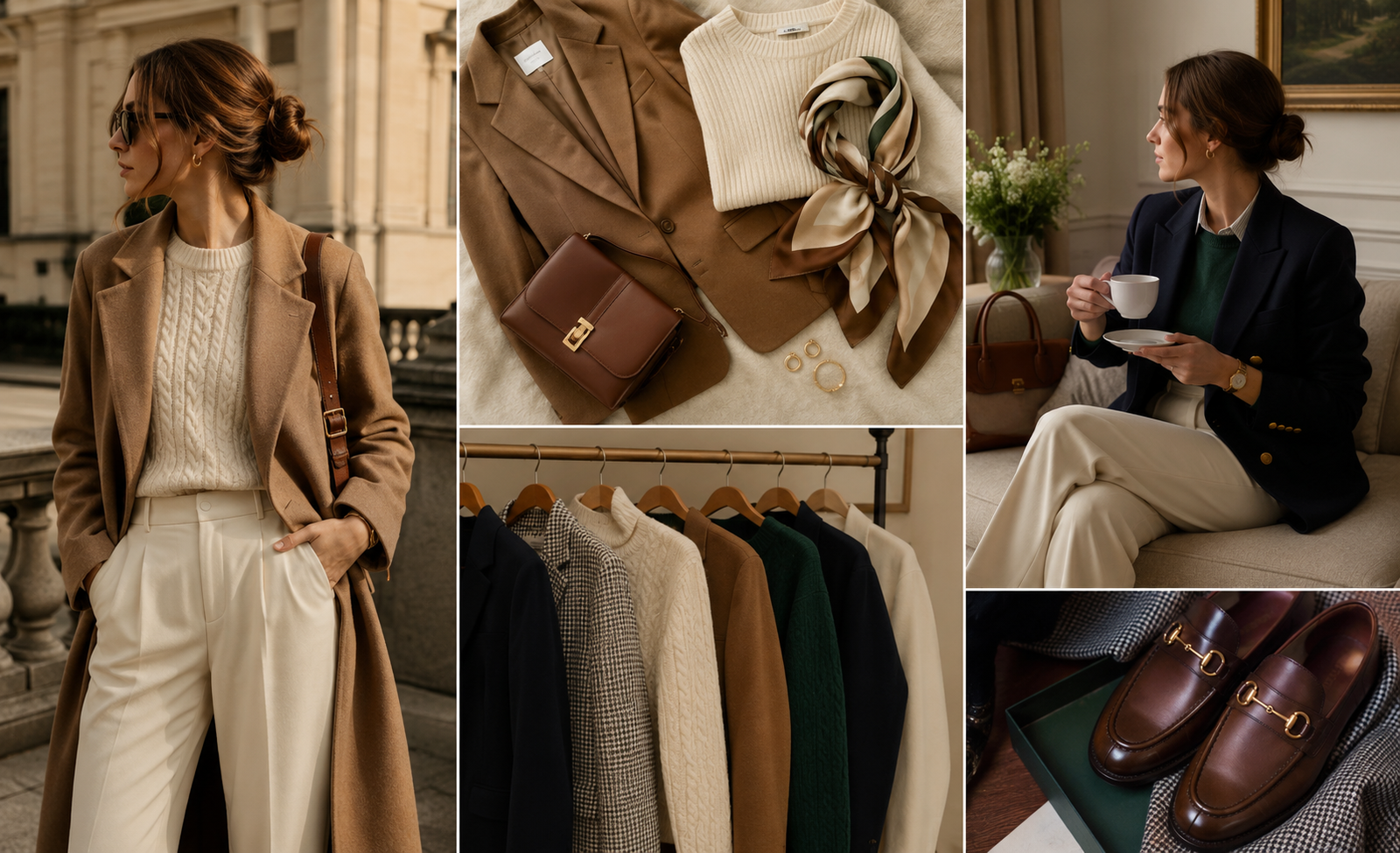
While specific styling choices vary, a handful of pieces show up consistently across old money-inspired wardrobes:
- A well-tailored blazer, ideally in a neutral tone like navy, camel, or gray
- Wide-leg or straight-leg tailored trousers, which read as more polished than skinny-fit alternatives
- Cable-knit or fine-gauge sweaters, particularly in cream, camel, or muted jewel tones
- A structured trench coat or wool overcoat, chosen for longevity over trend
- Loafers or riding-style boots, favored over trend-driven sneaker silhouettes
- A simple silk scarf, either worn traditionally or tied to a bag as an accent
None of these pieces need to come from a specific designer label to work — the aesthetic is achievable at a wide range of price points once the silhouette, fabric quality, and color palette are prioritized correctly.
Building the Look Without a Luxury Budget
This is where old money style becomes genuinely more accessible than people often assume: because the aesthetic prioritizes cut, fabric, and color over logos or brand names, well-made pieces from mid-range or budget-friendly retailers can achieve a very similar effect to their designer counterparts, especially when chosen carefully. A well-tailored, neutral-toned blazer from an accessible retailer photographs and reads almost identically to a far more expensive equivalent, provided the fit and fabric quality hold up.
A few practical strategies for building the look affordably:
- Prioritize fit and tailoring over brand name, since a properly tailored budget piece consistently outperforms an ill-fitting expensive one
- Shop secondhand and consignment for higher-quality pieces (cashmere, wool coats, leather goods) at a fraction of retail cost
- Build slowly around a core neutral palette rather than buying an entire wardrobe at once
- Invest more in the pieces worn most frequently (a coat, a blazer) and spend less on trend-adjacent extras
For anyone wanting a more detailed breakdown of specific budget-friendly pieces and where to find them, this guide to old money outfits on any budget goes further into practical shopping strategies and specific outfit combinations across different price points, which is worth a look if you’re building the aesthetic from scratch.
Color Palette: The Detail That Ties It All Together
Perhaps more than any single garment, color palette is what makes an old money-inspired outfit read as cohesive rather than random. The aesthetic favors muted, warm neutrals — camel, cream, navy, forest green, chocolate brown, soft gray — over bright, saturated, or neon tones. Even when color is introduced, it tends to lean toward deeper, richer versions rather than anything overly vivid.
Sticking to two or three coordinated tones per outfit, rather than introducing several competing colors, does more to achieve the look than any individual piece.
Common Mistakes That Undercut the Aesthetic
A few recurring missteps tend to pull an outfit away from old money styling, even when individual pieces are well chosen:
- Leaning too trend-driven. Fast-fashion trend pieces, however well-styled, tend to work against the timeless foundation the aesthetic is built on.
- Over-accessorizing with logos. Visible branding tends to clash with the understated, quality-over-logo philosophy central to the look.
- Ignoring fit. Since the aesthetic relies heavily on tailoring, an ill-fitting piece undercuts the polished effect far more noticeably than in more casual style categories.
- Overloading the color palette. Too many competing tones in one outfit disrupts the cohesive, understated effect the aesthetic depends on.
Frequently Asked Questions
Do I need designer pieces to achieve old money style?
No — the aesthetic prioritizes fit, fabric, and color palette over brand name, which means well-chosen mid-range or secondhand pieces can achieve a very similar effect.
What’s the biggest difference between old money and quiet luxury?
Quiet luxury leans more minimal and streamlined, while old money pulls from more traditional, preppy-adjacent references like tailoring, equestrian influences, and a warmer color palette.
What colors work best for this aesthetic?
Muted, warm neutrals — camel, cream, navy, forest green, and chocolate brown — form the foundation, with brighter or neon tones generally avoided.
Is old money style the same as preppy?
They overlap but aren’t identical. Preppy tends to be brighter and more playful, while old money leans quieter, more muted, and slightly more formal.
Final Thought
Old money style ultimately comes down to restraint, quality, and consistency rather than any specific price tag. Once you understand the philosophy behind the aesthetic — timeless over trendy, understated over overt — building toward it becomes far more achievable than it might initially seem, regardless of budget.
For complete outfit breakdowns across dresses, casual wear, and seasonal looks, Style Blooming’s timeless old money outfit guide walks through full looks suited to a range of budgets and occasions.
About the Author