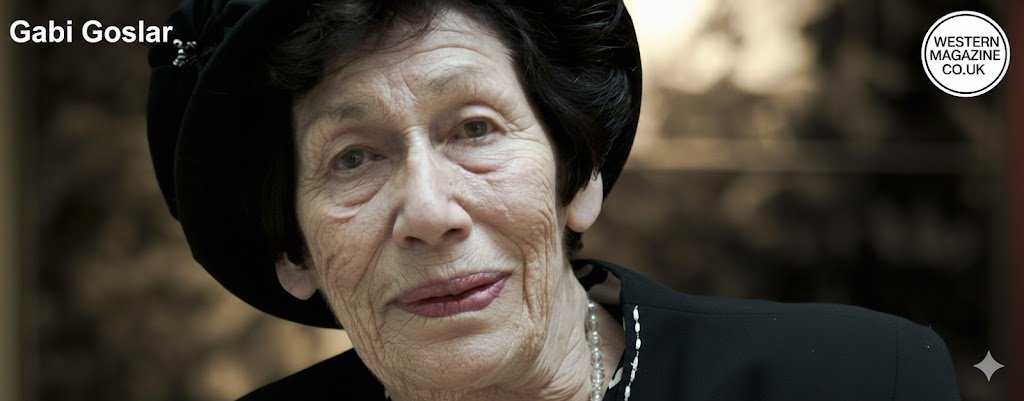
Gabi Goslar
Introduction:
Gabi Goslar, a name not widely known outside historical circles, played a pivotal role in the story of one of the most famous victims of the Holocaust, Anne Frank. Born into the turbulent years leading up to World War II, Gabi’s life was profoundly affected by the rise of Nazism and the brutal persecution of Jews during the war. Her life story, alongside that of her older sister, Hannah Goslar, sheds light on the human costs of hatred and the enduring impact of friendship in the darkest of times.
This article explores Gabi Goslar’s life, her connection with Anne Frank, and her legacy as a survivor of the Holocaust.
1. Early Life and Background of Gabi Goslar
Gabi Goslar was born Rachel Gabriele Ida Goslar on October 25, 1940, in Amsterdam, Netherlands. Her family was part of a large Jewish community in the city, and her parents, Hans Goslar and Ruth Judith Goslar‑Klee, had fled Nazi Germany to escape increasing anti-Semitic persecution. The Goslar family hoped to find a safe haven in the Netherlands, but as the war escalated, Amsterdam would become a city under Nazi occupation.
Gabi was only a toddler when the Nazis invaded the Netherlands in 1940. The war, however, didn’t spare her family’s dreams of normalcy. Tragically, her mother died during childbirth when Gabi was just two years old. She was left with her older sister, Hannah, and her father, who did his best to shield them from the growing horrors of Nazi occupation.
Despite the loss, Gabi’s early years were still marked by the presence of strong, enduring bonds with their neighbors and friends, most notably the Frank family. It was during this period that her older sister Hannah formed a lifelong friendship with Anne Frank, who would become the world’s most famous diarist. Through this connection, Gabi’s life would become woven into the tapestry of one of the most poignant and tragic histories of World War II.
2. Gabi Goslar The Nazi Occupation and the Persecution of Jews
Like many Jewish families in Amsterdam, the Goslars faced increasing persecution as the Nazi regime imposed severe restrictions on their rights. Jews were forced out of schools, public spaces, and work opportunities. As the war wore on, conditions worsened. In 1942, the family was forced to move into one of Amsterdam’s Jewish districts, a step closer to the inescapable fate facing many Jewish families in Europe.
During this period, Hannah Goslar became very close friends with Anne Frank, and the two spent significant time together. Anne Frank’s diary, which would later become the most widely read and influential book about the Holocaust, chronicles her own experiences during these times, but also alludes to the Goslar family and their resilience in the face of oppression.
Despite being separated by age, Gabi and Anne were both victims of the systemic persecution against Jews. Their experiences during the Nazi occupation would bind them together in the most tragic of ways.
3. Gabi Goslar Deportation and Survival in Bergen‑Belsen
In 1943, the Goslar family was deported to the Westerbork transit camp in the Netherlands. This camp was a staging ground for Jews who were being sent to concentration camps in Germany and Poland. The family spent months in Westerbork before being transported to the Bergen‑Belsen concentration camp in northern Germany in February 1944.
Bergen‑Belsen was one of the worst places on earth during World War II, notorious for its extreme overcrowding, poor sanitation, and a lack of food. Although it was not a dedicated extermination camp like Auschwitz, Bergen‑Belsen had a high death rate due to disease, starvation, and inhumane living conditions. The arrival of Gabi and her family marked the beginning of their most difficult period of suffering.
The same camp also housed Anne Frank, who had been deported from the Netherlands to Auschwitz, and later sent to Bergen‑Belsen. The encounter between Gabi and Anne is a poignant moment in the history of the Holocaust. Despite being separated by the barbed wire fences, the two girls found ways to communicate through brief exchanges and messages.
4. A Heartbreaking Reunion with Anne Frank
One of the most haunting parts of @Gabi Goslar’s life story involves her connection to Anne Frank during their time in Bergen‑Belsen. While Anne Frank’s world-famous diary documents her life in hiding before her capture, it was in Bergen‑Belsen that Anne’s fate tragically unfolded. By 1945, Anne had contracted typhus, a deadly disease that was ravaging the camp. Despite Gabi and her sister’s best efforts to offer Anne whatever comfort they could, the disease eventually claimed Anne’s life just weeks before Bergen‑Belsen was liberated by Allied forces.
The moment of contact, the small exchanges between the two girls over the barbed wire, is captured in Gabi’s memories as one of the most emotional moments of her life. Gabi recalled how her sister, Hannah, managed to sneak food, including a small package of bread and sugar, to Anne — a desperate but heartfelt gesture in a place where hope was scarce.
Sadly, Anne Frank died in early 1945, just before the camp was liberated. But the bond between Gabi and Anne would remain in Gabi’s memory for the rest of her life. It was a symbol of the powerful connections people made in the worst of times — and the unbreakable strength of human friendship.
5. Gabi Goslar Liberation and the Aftermath
In April 1945, the Allied forces liberated Bergen‑Belsen, but the survivors of the camp were left deeply scarred by the horrors they had endured. Gabi, though physically weakened, was one of the lucky ones who survived the camp. Tragically, her parents had perished during the war, and the world Gabi had once known was shattered beyond recognition.
After the liberation, Gabi and her sister Hannah were eventually able to return to Amsterdam. They reunited with other Jewish survivors and later emigrated to Israel in 1947, joining a growing number of Holocaust survivors who sought refuge and a fresh start in the newly established state. Gabi went on to build a life in Israel, where she married and had children, although her personal story remained more private than that of her older sister.
6. The Legacy of Gabi Goslar
While Gabi Goslar may not be as widely known as some of the other Holocaust survivors, her legacy is profound. Gabi’s role in Holocaust remembrance cannot be understated. As one of the few remaining survivors who knew Anne Frank personally, her testimony serves as an essential part of the historical record.
In recent years, Gabi and her sister Hannah have shared their story through interviews and appearances, helping to preserve the memory of their time in the camps. Their personal recollections contribute to the collective memory of the Holocaust, ensuring that future generations never forget the horrors of that time.
Today, Gabi’s story — like that of Anne Frank — continues to serve as a powerful reminder of the human capacity for survival and resilience in the face of unimaginable hardship. Holocaust survivors like Gabi are the living witnesses of one of the darkest chapters of human history, and their voices help keep the lessons of that era alive for future generations.
7. Gabi Goslar Net Worth and Financial Status
While many historical figures are often measured by their financial standing, Gabi Goslar’s net worth is not a subject that holds relevance to her life’s legacy. She was not a public figure engaged in wealth accumulation but rather a survivor and a witness to history. There are no credible reports or publicly available information regarding Gabi Goslar’s financial status or personal wealth.
Her significance lies not in the material, but in the stories she has helped preserve, in the suffering she overcame, and in the message she carries forward from a generation lost to history. Her net worth, therefore, remains irrelevant compared to the wealth of wisdom, courage, and resilience she has passed on to the world.
Conclusion
Gabi Goslar’s story is one of resilience, survival, and unbreakable human bonds. While her connection to Anne Frank remains one of the most emotional and enduring aspects of her life, Gabi’s experiences go far beyond that singular relationship. As a Holocaust survivor, she represents the millions of lives disrupted and destroyed by hatred and prejudice.
Her life, lived quietly after the war, serves as a reminder that the real wealth of a person lies in their contributions to humanity, their perseverance through adversity, and the indelible marks they leave on history. In preserving the memories of the Holocaust, Gabi Goslar has ensured that the horrors of the past are never forgotten and that future generations learn from the mistakes of history.
While Gabi Goslar may not have achieved fame in the traditional sense, her legacy is immortal — as a survivor, as a witness, and as a symbol of the strength of the human spirit.
About the Author