Basic Knowledge
It might sound like a trivial part of an electric system, but battery terminals are important because they help to provide dependable power distribution in diverse uses. This paper will discuss the various kinds of battery terminals, the materials they are made of, how they affect the transfer of power, and what good habits can be used to make them safe and effective in their usage.
Types of Battery Terminals (e.g., Lead-Acid, Marine, Automotive)
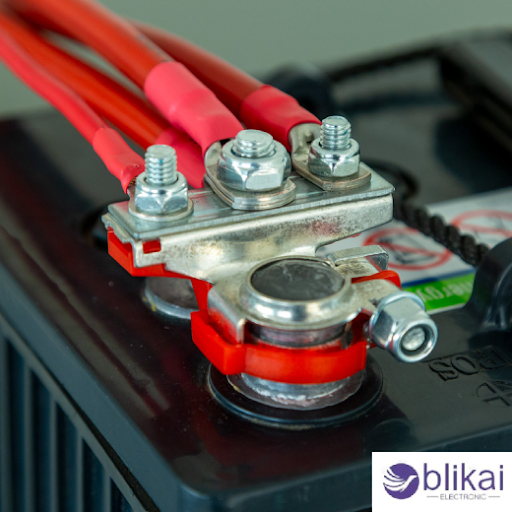
Battery terminals are available in a variety of configurations, each engineered to meet the unique electrical and mechanical demands of different battery applications. In the automotive world, the most widely used terminal types are SAE top-post terminals and side-post terminals. Top-post terminals are cylindrical and sit on top of the battery, labeled positive (+) and negative (–), and are compatible with most 12-volt lead-acid batteries. Side-post terminals, on the other hand, are threaded and mounted into the side of the battery casing, typically found in General Motors vehicles. These offer a more compact footprint and are often favored in tight engine compartments.
Marine battery terminals are often hybrid in design, incorporating both wingnut-style threaded studs (for accessory connections) and standard automotive top posts. This allows simultaneous connection of critical onboard electronics—like fish finders, trolling motors, and radios—without compromising the primary engine circuit.
When you go to industrial and deep-cycle battery systems, specifically in forklift, solar energy storage and backup power systems, you tend to come across L-terminals, stud terminals or flag terminals. They also have a design that can handle constant high-amperage loads and can be used to make bolted, vibration-free connections, vital in highly demanding or highly vibrational applications. Using the right type of terminal with respect to the system voltage, current draw, and physical restrictions provides a fitment, conductivity and durability of the electric connection.
Common Materials Used (e.g., Lead, Brass, Copper)
Selection of a battery terminal material is critical in order to achieve electrical efficiency, to resist corrosion, and to suppress mechanical failure. The oldest and cheapest one will be the lead terminals that are frequently used in OEM automotive batteries. Lead is malleable, so it fits well mechanically with the battery post. At low loads, it is not vulnerable to oxidation or mechanical fatigue failures; however, when loaded heavily or pressed in and out many times, it is prone to mechanical fatigue failure.
Copper terminals can provide better conductivity (often comparable to 100% IACS or International Annealed Copper Standard) in high-performance or aftermarket applications and are better suited than other materials to deliver power efficiently, due to their low resistance. They are suitable for use in performance vehicles, sound systems or where cranking power is needed quickly and steady. But copper is more susceptible to oxidation on the surface and, as such, is commonly tin-plated to raise its corrosion resistance.
Brass terminals are conductive (about 28 percent IACS) and anti-corrosive, so would be recommended where a marine or outdoor application is necessary. Metal is also strong mechanically, and they are corrosion resistant to salt water, hence its use in boats, RVs and off-grid solar systems. Some high-quality battery terminals may involve alloyed blends or incorporate nickel or zinc plating so as to improve durability when in extreme conditions even further. The electrical, environmental trade-offs and understanding how each material works will be important in selecting terminals that could provide both characteristics in your particular application.

The Way Battery Terminals Work Regarding Power Transmission
Battery terminals are the most vital connection points where an electric current enters and leaves the battery and forms the entire loop of current that is needed to energize the electrical system. The positive lead can deliver current to operate the starter motor, the ignition system, and other heavy-load components; the negative lead delivers current back to the battery, after it has loaded the system. This movement of electrons should not be disrupted or met by resistance, and this should be assured so that the entire system, ranging between the engine control unit (ECU) and lighting systems, as well as infotainment systems, would be used in the range designed with respect to the voltage limits.
A corrosion-free terminal, along with a good torque on the terminal, guarantees that the contact resistance is low; this prevents voltage drops and creates too much incidence of heat generated. A very small resistance at the interface of the end terminal, such as in a few milliohms, also may result in inefficiency and unstable voltage delivery to sensitive electronic systems, causing them to malfunction or reset. Poor terminal contact in a high current application (as in starting a vehicle) can allow a voltage sag to occur, which causes a slow-cranking or possible no-start.
In addition, electrically conductive terminals that are to be properly secured may cause poor connection and cause electrical arcing. Not only does this increase the wear on the terminal and the post, but it may also generate heat sufficient to destroy the casing of the battery or the insulation of nearby wiring. In the long run, these problems can spill over into larger electrical problems, blown fuses, ECU faults, or even thermal events. Thus, battery terminals cannot be considered just passive, but as active power transfer components that should be periodically inspected, cleaned, and checked for the tightness of the torque to maintain the system integrity and long life.
Conclusion
Although it is commonly ignored, battery terminals form the important backbone of any power system, as it is the main point of entry of energy between the battery and the attached devices. Appropriate selection of movement type and material, proper installation, frequent maintenance and safe handling, all these and much more need to be taken into consideration in order to squeeze the maximum performance out of terminals and expect minimum risk of lightning strikes.
About the Author